

The 2026 Finance Act marks a historic turning point in the modernization of Tunisia’s tax system. Article 53 of Law No. 17-2025 formally extends the requirement for electronic invoicing to the entire service sector, affecting more than 380,000 professionals and businesses. This measure builds on the reforms initiated in 2016 and represents a major change for Tunisia’s economic ecosystem.
1. Scope of Application: Who Is Affected by the New Requirement ?
1.1 Comprehensive Expansion into the Services Sector
Section 53 amends Section 18 of the VAT Code to require electronic invoicing for all service transactions, without exception. This requirement applies in particular to:
- Professionals: Lawyers, doctors, accountants, architects, engineers, consultants
- Business services: Telecommunications providers, insurance companies, consulting firms
- Tourism and hospitality sector: Hotels, travel agencies, restaurants
- Transportation and logistics: Freight and passenger carriers
- Small businesses and craftsmen: Repair, installation, maintenance.
1.2 Universal Application Criteria
This requirement applies without exception to:
- Amount billed
- Company size
- Tax regime (actual or flat-rate)
- Legal status (individual or legal entity)
- Breakdown of revenue (domestic or export)
1.3 Special Cases Included
- BIC flat-rate scheme: Applies to all commercial transactions other than purchase and resale.
- Combined transactions: Sales of goods that include related services (transportation, installation, repair).
- Professionals already subject to these requirements: Existing obligations for government contractors and large companies remain in effect.
2. Legal Framework and Strengthened Penalties
2.1 Changes in the Regulatory Framework
- 2016: Introduced by the 2016 Budget Act
- Decree 2016-1066: Operational implementation
- 2025-2026: Expansion and strengthening of sanctions
2.2 Official Platform
Tunisie TradeNet (TTN) remains the designated body responsible for managing El Fatoora, the national platform for processing electronic invoices.
2.3 Sanctions Regime (Article 53)

3. Roadmap to Compliance
3.1 Essential Prerequisites
- Qualified electronic signature certificate issued by the ANCE (National Electronic Certification Agency)
- The TEIF (Tunisian Electronic Invoice Format) is mandatory for all invoices
3.2 5-Step Sign-Up Process

Step 1: Electronic Certification
Application to ANCE (TunTrust)
Average processing time: several weeks
Cost varies depending on the type of certificate
Step 2: Signing up for El Fatoora
Documents to be submitted:
- TTN Subscription Agreement (2 copies)
- Fact Sheet
- Supporting documents:
- Extract from the commercial register
- Tax ID card
- Copies of the legal representative’s and director’s ID cards.
Step 3: Testing Phase
Technical validation by TTN:
- Generation of TEIF invoices
- Electronic signature
- Transmission via Web Service/SFTP
Step 4: Deployment
- Access to the production environm
- Assignment of permanent access
- Issuance of the membership certificate.
Step 5: Administrative Procedures
Filing with the tax authorities, including:
- TTN Certificate
- Compliance Commitment
- Information on the technical resources used
4. Financial and Logistical Considerations
4.1 Costs of Digitization
- TTN processing: Starting at 0.190 DT (excluding tax) per invoice (for 50 KB)
- Additional copies: Volume discounts available upon request
- Electronic certificate: Cost varies by accredited provider
- Solutions logicielles: Investissement variable selon l’outil choisi
4.2 Critical Deadlines
- Processing time for ANCE certificate: 4 to 8 weeks
- TTN application processing: 2 to 4 weeks
- Integration testing: 1 to 3 weeks
- Estimated total: at least 2 to 4 months.
5. Challenges and Opportunities for Businesses
5.1 Key Challenges
- Implementation timeline: A lengthy, sequential process
- Technical complexity: Proficiency with the TEIF format and ERP integration
- Overload of service providers: Risk of delays due to a surge in requests
- Team training: Adapting internal processes
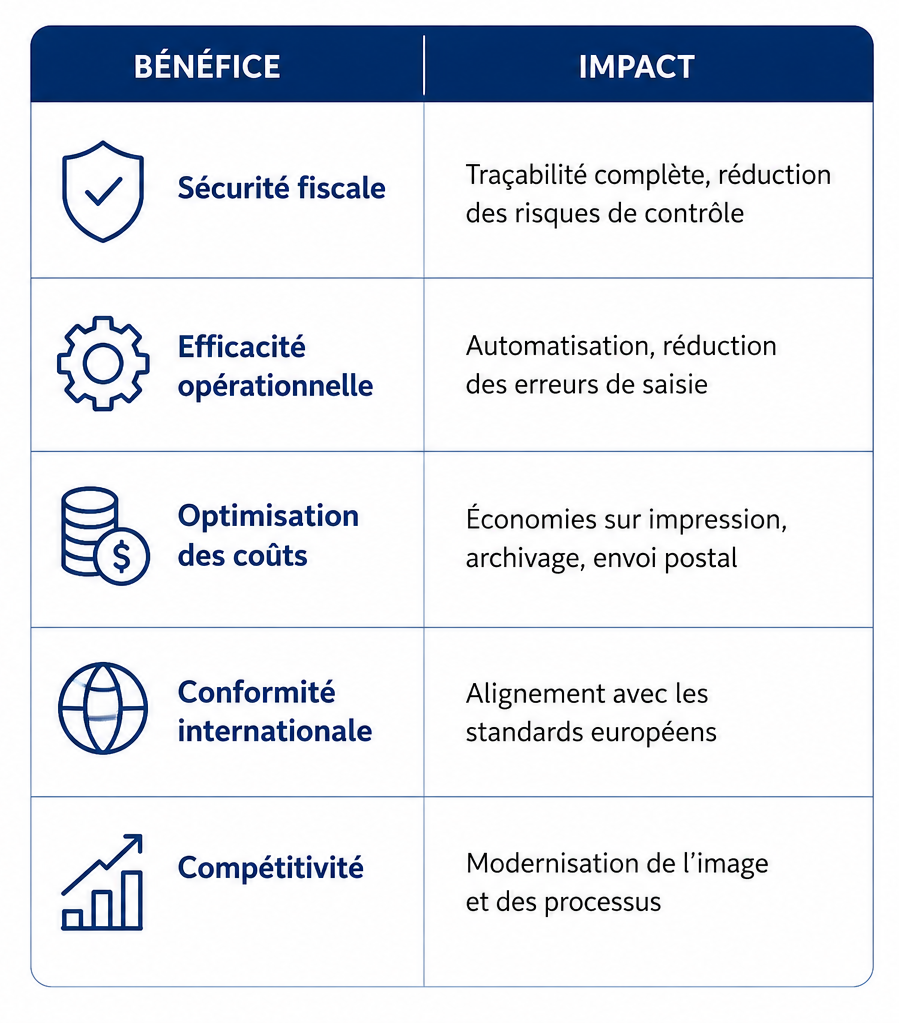
5.2 Tangible Benefits
6. Strategic Recommendations
6.1 Immediate Anticipation
- Get started now: The entire process takes several months
- Priority for electronic certificates: The first critical link in the chain
- Audit of existing processes: Identify necessary adjustments
6.2 Selection of Technical Solutions
- Evaluation of options: Direct implementation vs. specialized service provider
- ERP compatibility: Verify integration capabilities
- Turnkey solutions: Explore offerings from approved software vendors.
6.3 Organizational Preparation
- Team Training: Train sales, administrative, and accounting teams
- Process Adaptation: Adjust validation and document archiving workflows
- Transition Plan: Establish a transition period with technical support and user assistance.
Implementation Deadline: January 1, 2026
For further details, please refer to Joint Circular No. 10/2025 dated June 19, 2025.
6.4 Ressources Utiles
Tunisie TradeNet: tradenet.com.tn
El Fatoora Electronic Invoicing Platform: https://www.elfatoora.tn
ANCE: tuntrust.tn